
CONTOC Germany was led by
Ilona Nord, Wolfgang Beck, Georg Lämmlin
Cooperation partners in the CONTOC Germany research group:
Oliver Adam, Jürgen Deniffel, Simon Eckhardt, Friederike Horn,
Viera Pirker, Hilke Rebenstorf, Ann-Kristin Renneberg,
Gunther Schendel, Hermann-Josef Wagener
Overall direction of the international CONTOC study:
Thomas Schlag, Ilona Nord, Sabrina Müller, Wolfgang Beck, Arnd Bünker, Georg Lämmlin.
Cross-denominational findings
Last year, CONTOC (Churches Online in Times of Corona) conducted an international, ecumenical survey of pastors and church professionals in parishes. During the field phase from 29 May to 12 July 2020, 1,551 people participated via Catholic dioceses and 2,407 via Protestant regional churches. With more than 3,000 data records from Germany, the research group can draw on a rich data basis to describe in detail the worship, pastoral, diaconal and educational practice in the parishes during the first phase of the pandemic. The starting point was the cancellation of services in March 2020, especially for Holy Week and Easter, and the restrictions on personal encounters in church contexts.
The study centrally examines how professionals of the Catholic and Protestant churches in Germany dealt with digitalization processes. This includes, for example, research into respondents’ professional and private use of social media as well as questions about virtual forms of cooperation. The survey asked about the use of digital media in the churches’ central fields of action and about the practitioners’ understanding of their roles. Cooperation with volunteers in the parishes was as much in focus as the perception of support from church governance structures and the assessment of the need for action in the churches. Data were collected on worship, pastoral care, diaconia and education, on the role of professionals in parish ministry, and on how they dealt with the challenges of the pandemic.
A surprising result: three quarters of respondents see opportunities rather than risks in digitalization processes within church communication (see fig. 1).
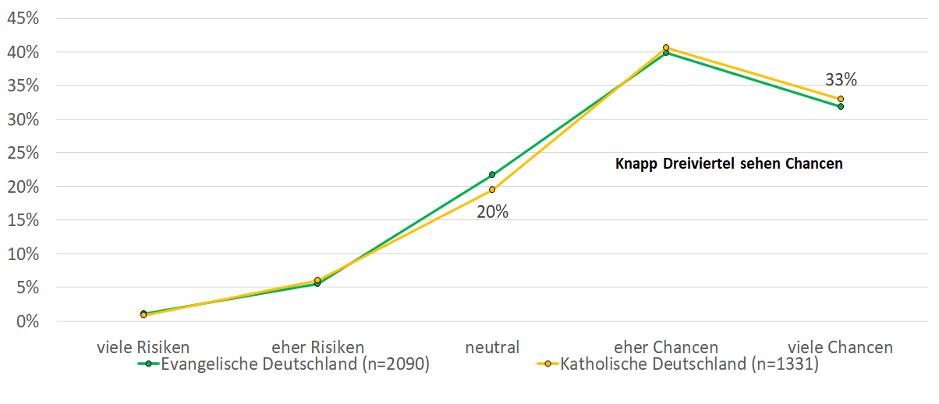
Given the many church communications of recent years that viewed digitalization rather critically, different results had been expected. Almost two thirds of respondents also answered positively when asked about their participation in digital communication, especially social media, both personally and professionally; about half stated that their parish maintains an account on at least one social media platform. Almost 80% consider themselves at least averagely skilled, only about one fifth rather inexperienced. Of course there are respondents who – as our representative study shows – did not use digital media during the first lockdown.[1] This can have very different reasons: not only the attitude towards digital media (will), but also the equipment (tool) and the competence (skill) influence the use of digital media in church communication.
There were also repeated indications that respondents themselves did not communicate digitally but that others in the parish took on this task. What emerges among respondents is a calm, realistic attitude rather than excitement or emphasis: neither the quantitative nor the qualitative data give reason to speak of “tech hype” or “tech fear”. We live in times in which digitalization has become the normal case and has to be dealt with concretely, instead of arguing whether it should be fought as a global process. Most respondents use digital media[2] or consider their use by others working in the parish productive for church communication.[3] At the same time, a need for theological reflection on church practice is indicated – the more one communicated digitally, the stronger. 95% of respondents streamed a worship service for the first time during the first lockdown.[4] A new format for parish work was thus tested at scale.
Many now find it important to penetrate this experiment theologically: how and what changes about services when they are ‘produced’ for streaming? Producing and consuming are not generally accepted vocabulary when it comes to worship. What do such developments mean for the community of believers – are they really radically new, or do existing dynamics ‘merely’ continue? What does this mean for the role of liturgists? These and other questions were newly generated by the experiences of the pandemic, became visible and relevant beyond specialist circles, and will stay with us. The present study therefore understands itself above all as a project for generating questions for current church development.
The CONTOC study was designed for a representative sample. The reference population was defined as the professionals working in pastoral ministry, who were contacted directly via official e-mail lists and invited to the online survey. On the Protestant side the regional churches of the EKD participated, on the Catholic side the dioceses. Both the size of the sample and the distribution of socio-demographic characteristics (age, gender, geography) indicate a representative selection, though not evenly across the EKD regional churches and the dioceses. The disproportionate participation of women in the gender distribution can be compensated by weighting the data set – and it also draws attention to how strong women’s participation in the survey was.
The suspicion that an online survey would primarily reach digitally affine people is put into perspective by the representative distribution of the socio-demographic data and by the finding that about one fifth of participants had not developed or offered any online worship formats themselves. With some caution regarding subsystems, the picture can therefore be considered representative for the situation in the pastoral fields of action during the first lockdown.
It is also striking that women and men among the respondents use digital media and consider them relevant for parish work without any notable difference. They predominantly believe that digital communication fosters connectivity among parish members. Digitalization processes by no means led the professionals surveyed to perceive a loss of function or a change of role. Respondents show clear role stability; the crisis may even have triggered renewed engagement with specific markers of identity and thus a reflection that stabilises one’s personal position. However, respondents predominantly see that the forms of presence of their activities change through digital formats.
Willingness to innovate & potential
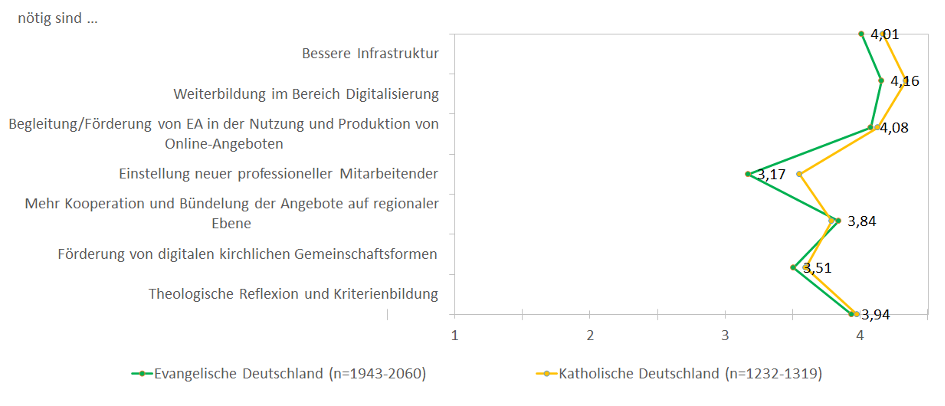
It can also be seen that reception habits are changing and that cooperation with volunteers was highly important in the crisis. At the same time, these activities made clear how important digital competence is for pastoral ministry. Regarding the need for action, both further training and theological reflection and criteria formation receive very high approval, while the question of hiring new professional staff is answered rather cautiously. Looking back at the first phase of the pandemic, pastoral practitioners thus focus on their own communicative and theological development (see fig. 2).
Overall, for both denominations, the survey shows how much the crisis reveals the respondents’ willingness and potential to innovate. They want to achieve changes in the usual organisation of work; they were pleased about the reduction of meeting and administration time during the first lockdown and saw in it the chance to concentrate anew on activities that are important and meaningful to them. Two statements from the open questions of the online survey, which can be read as widespread patterns of argument, illustrate this:
The corona crisis is an opportunity for the church to reorient itself. It has, at least in part, given us the time to try out and dare new things that we otherwise do not have. Conclusion: if we take our time away for too many obligations, no time remains for daring something new.
KV, l. 231–234 (translated from German)
Corona has done my parish a surprising amount of good, even though it is of course a catastrophe for society. Without corona there would not have been half as much creativity, commitment and freedom to experiment here.
KV, l. 235–237 (translated from German)
Digital communication – as mentioned above with regard to the digital church – was not seen as a radically new form of church, but as a complement to familiar and traditional forms. Again two exemplary statements:
… As an alternative in times of crisis yes, but not as a replacement for analogue services.
GD-P, l. 40–41 (translated from German)
… The church’s online offering is indispensable. But the greater part of the bond with a church happens through personal contacts and role models, which can then perhaps be complemented, strengthened, continued, expanded and deepened digitally.
OK, l. 181–184 (translated from German)
During the first lockdown, the pandemic gave the field of worship high importance both internally in parishes – not least because of the partly complete ban or restriction of assemblies – and externally in the journalistic public. Many of the respondents’ resources were invested here. A dynamic picture of worship practice emerges that on the one hand largely contradicts the public discourses of the pandemic period, and on the other hand, with its markedly participatory elements and practices, goes beyond the classic parish services of the pre-pandemic era. In dealing with digital services there is an attentive eye on reaching people to whom there is otherwise no contact (more pronounced among Protestant respondents)[5] or who are immobile (more pronounced among Catholic respondents).[6] The factor of family piety in the domestic context and the accompaniment of the house church was rediscovered in the pandemic.
Worship
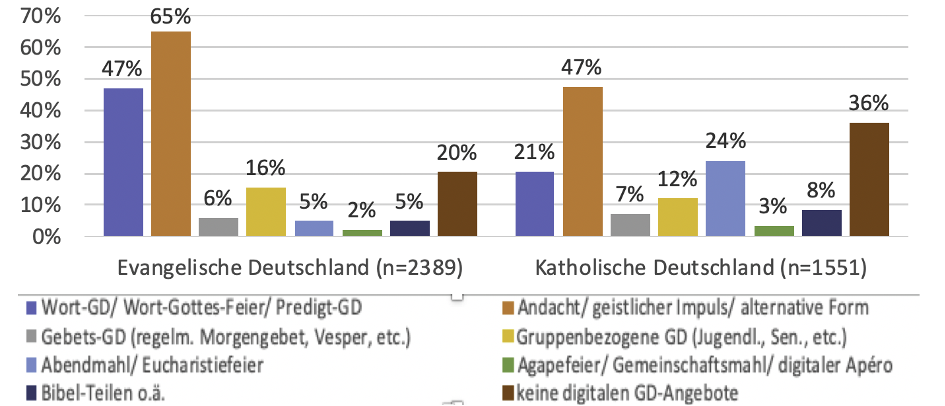
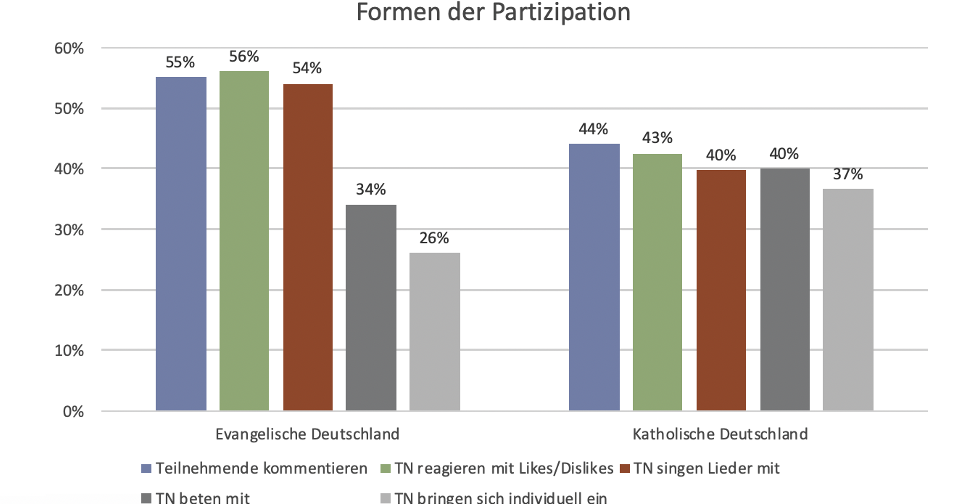
The design of the new worship formats is clearly oriented towards expectations and needs and includes different forms of active participation and co-creation (see fig. 3).
This is all the more astonishing since (especially in the Catholic church) the professionals missed important and expected support from diocesan offices, church leadership and middle institutional levels.[7]
Denominational differences appear regarding digital celebrations of the Lord’s Supper and the so-called digital Eucharist among Catholic respondents. Among Protestant respondents, 4% name the Lord’s Supper in the multiple answers on online worship forms, whereas 24% of Catholic respondents name the Eucharist. Fundamental differences in the understanding of worship (and their practical consequences) as well as the debate about a “digital Lord’s Supper” are likely to have had a strong influence, which is why these results should be interpreted with caution. Nevertheless they suggest that a discussion about the digital form of Eucharist and Lord’s Supper is called for.
Education
The field of education, especially for senior citizens, almost completely ceased across both denominations. E-learning emerged in the crisis as an important factor that is hardly practised in parish education – all the more important that regional churches, such as the Evangelical Lutheran Church in Bavaria, are currently setting a new focus here. It also becomes clear that during the first lockdown many places tried to continue confirmation classes in personal presence for as long as possible. Young people were to have the opportunity to meet as often as possible and to find themselves in a learning situation among those present that also allows for informal conversations and a fuller response to their life situations.
Pastoral care could be maintained through various, partly well-rehearsed formats such as telephone counselling in parish contexts, but new formats were also tried, such as digital group counselling via video chat.
For networking beyond their own parishes, respondents evidently had little energy left. Cooperation took place primarily in the immediate parish environment, only to a small extent with associations and local contacts. Parishes of other denominations or interreligious contacts played an even smaller role for mutual support. The question arises whether inter-parish, inter-denominational or interreligious cooperation was seen in the pandemic as an additional task and burden rather than as a resource.
Protestant focus
Striking, but not really surprising, are some differences in the Protestant sample between pastors in parish ministry and in functional ministry. Given the different areas of responsibility – in the parishes the entire programme of church offerings within a clearly defined region, in functional ministry the concentration on individual cross-parish fields – it is plausible that the first lockdown left different traces. Some questions can therefore only meaningfully be analysed for parish pastors.
Pastors in parish ministry show considerable differences in how far they felt able to fulfil their role. Hardly anyone doubted having lived up to the role of liturgist or being able to engage with the demands of digital communication, and almost three quarters even felt encouraged to become creative. Quite different for the role of pastoral counsellor: more than half felt they had not fully lived up to it. Pastoral care did take place on a broad scale, though less in digital formats (apart from telephone contacts) than through opportunities for personal accompaniment: supporting the bereaved and conducting funerals in an appropriate form; only institutional chaplaincy was judged hardly possible. We found that a part of the pastors (about 30%) was in fact rather inactive, the largest part (38%) provided pastoral care mainly by telephone, a smaller part (about 13%) was mainly active in group counselling, the others on all channels to a greater or lesser extent (see fig. 4).
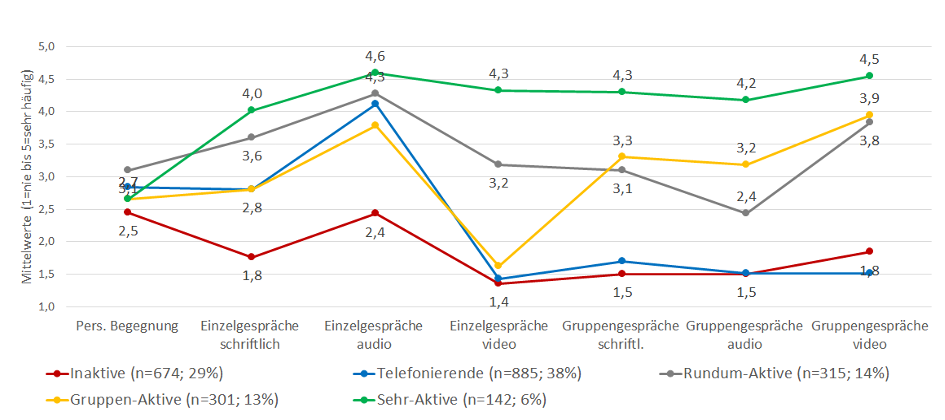
The degree of activity correlated with the type of ministry (parish or functional), the settlement type (rural–urban), gender, age and, of course, proficiency with online communication media. Accordingly, the greatest need for action is seen in further training in digitalization, while support especially from the middle level of one’s own church is appreciated.
Regarding education and participation, the quantitative data allow the following conclusions: attitudes towards digital media have changed, respondents’ digital competences have grown, and the digital equipment of the parishes has been evaluated or improved. Education in digital media was only of limited relevance or possibility for respondents; as providers they have gathered first experiences and can specify their needs. Education about digital media has led to its goal being seen in increasing participation, to its social dimension coming strongly to the fore, and to theological and social reflection on digital media setting in.
On this basis, categories were formed from the preliminary quantitative results for a qualitative structuring content analysis. The resulting category system was applied in the deductive analysis of the EKD data on the questions: “What is becoming less important?” (1,529 answers), “Where do you consider increased engagement meaningful?” (1,656 answers) and “What else I wanted to say …” (908 answers). The analysis of the Protestant data showed that during the first lockdown, learning with digital media predominated. Respondents had to learn to operate digital media within a very short time and named reaching people and their own role-model function as goals. Two statements from the qualitative data serve as examples:
[…] I have no idea how this is supposed to work. But I am determined to figure it out. My time horizon is the autumn holidays: by then I want to be able to film videos with two cameras with a manageable amount of time, edit them (including a separate audio track), have improved light and sound, have solved the upload and storage problems – and have built the network of people active in music, reading and my own language. […]
VP-LP, l. 189–194 (translated from German)
It was extremely challenging to first check every tool one was supposed to use for security gaps and then to take a position – for example not to take part in insecure video conferences (and to ask to be able to join simply by telephone in order to at least hear the contents), not to just quickly use certain online platforms, and to conduct the necessary communication with my office, by which I felt very well guided. […]
VP-LP, l. 199–205 (translated from German)
To the same degree, learning about digital media comes to the fore in reflection. The Protestant respondents demand not only professionalisation and further training in all digital and technical areas, but particularly emphasise critical engagement with the use of digital media.
Catholic focus
Among the fundamental observations of the CONTOC study in Germany is that a remarkably large share of pastoral workers felt strengthened in the crisis by their own faith and spirituality[8] and encouraged by the experience of the spring 2020 lockdown to shape the situation creatively through new forms of pastoral action.[9] This gave rise, especially in the area of worship, to many digital offerings that stand out for their variety of forms[10], their creation in teamwork with volunteers and colleagues, their dynamic further development through feedback[11] and the new forms of participatory involvement of those celebrating (see fig. 5).
The debates on the celebration of the Eucharist and the practice of confession that intensified in the Catholic church in spring, initially oriented mainly towards traditional understandings (such as the concept of “spiritual communion”, primarily known as an outdated form of church discipline), are classified by the great majority of respondents as unhelpful and hard to communicate.[12]
Both in the concrete design and in the pastoral evaluation of digital communication, open processes of searching can be observed among those responsible on the ground.
These activities are developed above all with local team colleagues and volunteers. For this to succeed, however, clear expectations are formulated: improvements in the qualification of church staff in dealing with digital formats, better technical infrastructure, and the employment of professional IT staff in the dioceses and regional churches.
Outlook and key points
CONTOC is a survey that reached respondents during the first lockdown. Much will have changed since. To capture these changes, those responsible are considering a next survey for spring 2022.
Key points of the survey so far are to be collected again: How has the handling of worship developed further – are streamed services, and thus religion online, still of broad interest, or have the tried-out formats of short devotions already changed the handling of digital culture as a whole? Are more people than before using formats that do not even exist in analogue form? Has cooperation behaviour in the parishes changed? What about online education formats – could they be intensified, or do they remain irrelevant? These and other questions arouse interest in the process set in motion by the pandemic.
[1] CONTOC-D, item DIGITAL3_SQ003 [I do not use … privately], 21.1% of respondents in the EKD data set.
[2] CONTOC-D, item DIGITAL3_SQ002 [I use … privately], 70.07% of respondents in the EKD data set.
[3] CONTOC-D, item DIGITAL4GD2_SQ004 [Digital offerings should enable community], 55.09% of respondents in the EKD data set.
[4] CONTOC-D, item DIGITAL4GD5_f, 94.3% of respondents in the EKD data set.
[5] CONTOC-D / cath. / prot., item DIGITAL4GD9_SQ001 (N cath. 1491 / N prot. 2292)
[6] CONTOC-D / cath. / prot., item DIGITAL4GD9_SQ004 (N cath. 1487 / N prot. 2243)
[7] CONTOC-D / cath., item WORK_SQ 006 (N 1504). Asked “To what extent did you feel supported by the diocesan leadership?”, 10.8% answered “did not feel supported at all”, 23.1% “little supported”, 26.9% “partly”. Only 12.7% answered “felt very well supported” and 26.5% “felt sufficiently supported”.
[8] In the Catholic sample, 75.6% of respondents state that their personal faith helped them particularly during the lockdown.
[9] CONTOC-D / cath., item WORK_SQ 004 (N 1546). 70.9% of Catholic respondents fully or rather agree with the statement “I felt encouraged to become creative”.
[10] CONTOC-D, items DIGITAL4GD1_SQ001 to SQ009 (N cath. 1551; N prot. 2389)
[11] CONTOC-D / cath., item DIGITAL4GD6_SQ002 (N cath. 827)
[12] CONTOC-D / cath., item DIGITAL4GD7_SQ002 (N 1418). To the statement “Spiritual communion is not understood”, 32% answer “fully agree” and 40% “rather agree”. CONTOC-D / cath., item DIGITAL5SEL3_SQ002 (N 1231). To the statement “People around me missed the possibility of confession”, 34.8% answer “does not apply at all” and 36.5% “rather does not apply”.
Recommended citation:
Churches Online in Times of Corona (CONTOC): Results of the CONTOC study, Germany section, building on the first ecumenical conference on 13 April 2021.
Recommended use of the figures:
Churches Online in Times of Corona (CONTOC): [name of figure], in: Results of the CONTOC study, Germany section, building on the first ecumenical conference on 13 April 2021.